Silicon Valley's journey. One region. Many beginnings.
Before the apps, there were orchards, mines, workshops and research labs. Explore ten chapters in the history of Silicon Valley, with Atherton as your local reference point.
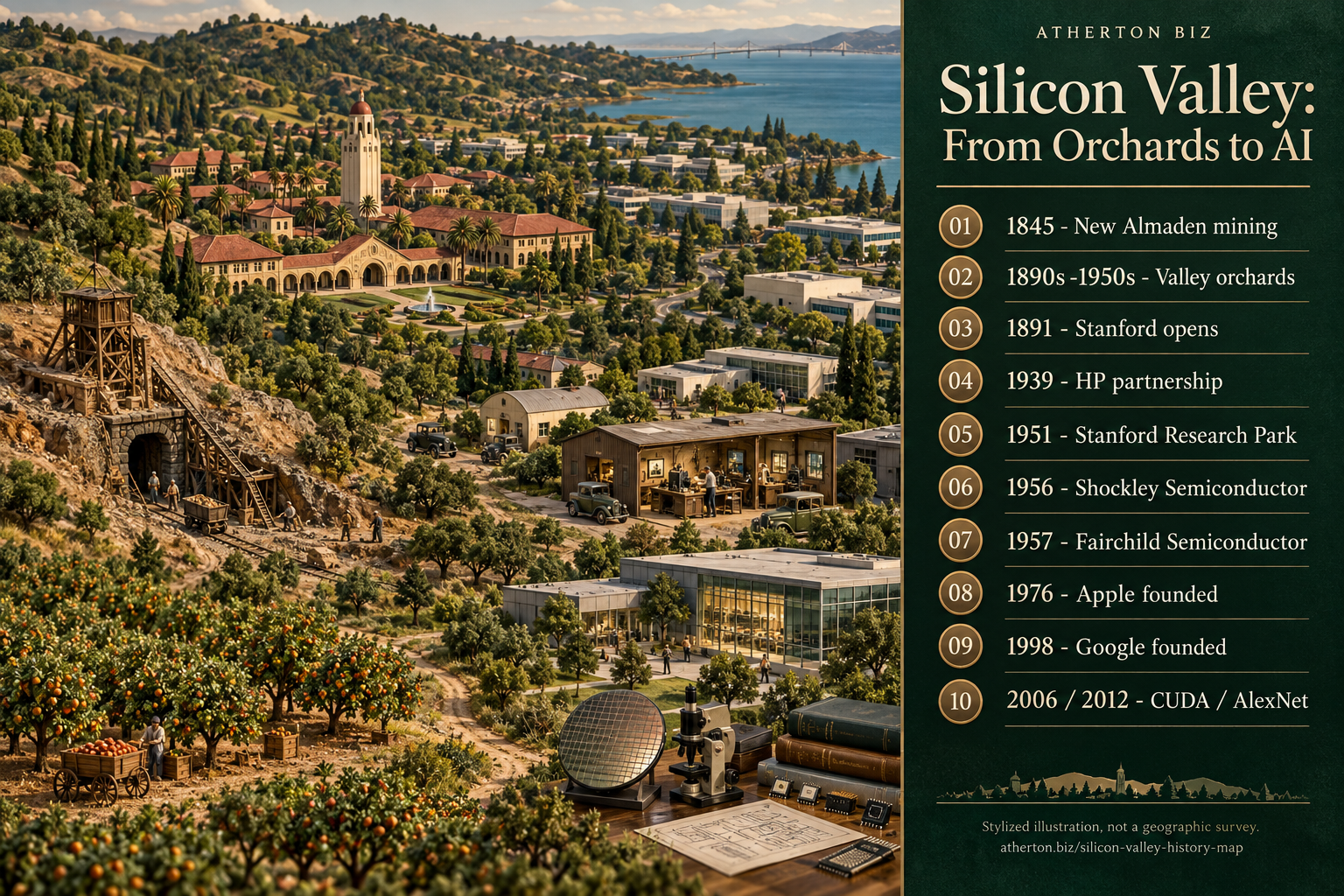
AI-created 3D editorial illustration. Terrain, buildings and distances are stylized, not surveyed locations or exact architectural reconstructions. Use the interactive map below for city-level geography and the timeline for historical sources. View full size.
This timeline starts with a mining milestone, not the beginning of human history here. Ohlone communities lived in the region long before these industries and continue today. The Muwekma Ohlone Tribe describes its ancestral homeland across much of the Bay Area, including the Santa Clara Valley. Read the Tribe's own account.
These ten chapters are an introduction, not a complete history. They do not cover every community, company, research institution or industry, and a sequence of dates does not mean each development directly caused the next.
The stories behind the points
A Silicon Valley history timeline
01
1845 / New Almaden
Mercury before microchips
Mining began at New Almaden in 1845. Its mercury helped process gold and silver, tying these hills to industries far beyond the valley.
The story includes hazardous work, international mining communities and a lasting environmental cleanup, not just mineral wealth.
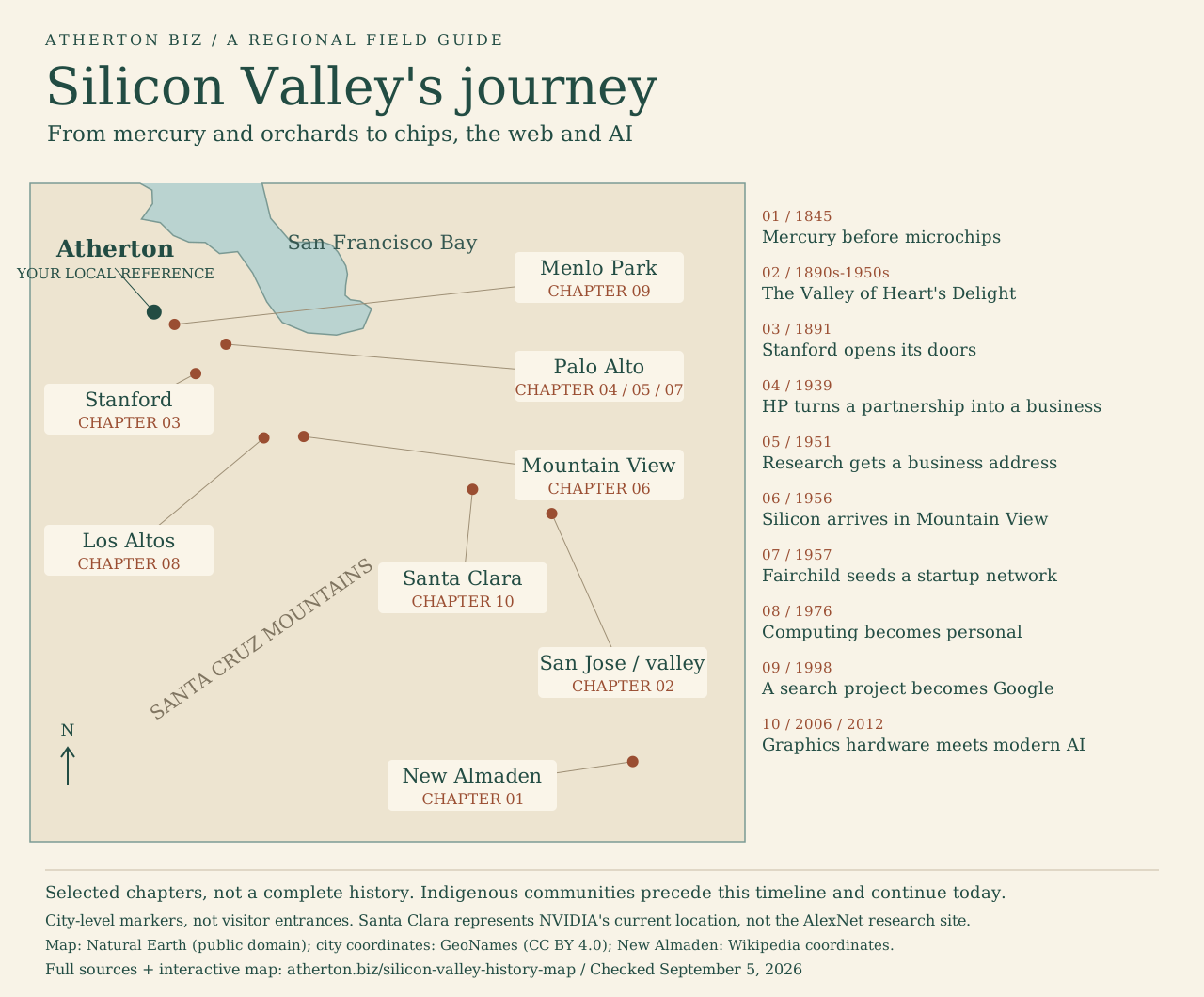
Map note: New Almaden area, south of central San Jose; not a mine entrance.
Fruit orchards gave the Santa Clara Valley its earlier nickname. Farm and cannery workers sustained an economy that cannot be understood through landowners alone.
History San Jose documents Chinese, Filipino, Italian, Japanese, Mexican and Portuguese seasonal workers. Agriculture and technology overlapped rather than changing on a single date.
Map note: San Jose is a regional reference for a valley-wide agricultural story, not one orchard.
Shockley Semiconductor Laboratory brought together engineers and scientists to work on silicon devices in Mountain View.
The venture's difficult management helped drive employees to leave. This milestone describes a technical and organizational turning point, not an endorsement of Shockley's views.
Map note: Mountain View city marker, not the laboratory's precise historical location.
Eight employees left Shockley's laboratory and founded Fairchild Semiconductor in 1957. Its early Palo Alto operation became a source of further semiconductor ventures.
The Computer History Museum traces a family of spinouts that includes Intel and AMD. Aerospace and defense demand also mattered to the industry's growth.
Map note: Palo Alto city marker for Fairchild's early operation, not its later offices.
Apple was founded on April 1, 1976. Its early Los Altos story is one chapter in the much wider movement to bring computers to individuals.
Do not confuse the early Los Altos association with Apple's later Cupertino headquarters. The region's personal-computing history extends beyond any one company.
Map note: Los Altos city marker; no home address, garage visit or public access is offered.
Google grew out of Stanford research and became a company in 1998. Its first office was a rented garage in Menlo Park.
The pin represents that early office city, not Google's later Mountain View campus. Research, financing and a useful web service came together across several places.
Map note: Menlo Park city marker; no private residence is identified.
NVIDIA unveiled CUDA in 2006, opening its GPUs to general-purpose computation. NVIDIA GPUs later powered the 2012 AlexNet breakthrough in computer vision.
AI has a much longer, international research history. AlexNet was not invented at this map pin; the marker represents NVIDIA's present corporate city.
Map note: Santa Clara is NVIDIA's current corporate location, checked September 5, 2026; not an AlexNet research site.
Download the 3D illustrated infographic or the original flat reference map. Both include chapter numbers and a link back to this source list. Neither is a route planner.
Markers show city or area reference points, not exact sites, property boundaries, visitor entrances or historical coastlines. Santa Clara identifies NVIDIA's present corporate city; it does not locate the AlexNet research. Private homes and corporate facilities are not offered as tour stops.
Turn over a few trivia cards and see which local stories surprise you.
Independent editorial guide, not affiliated with the organizations featured. Historical details may be revised as sources improve. Suggest a correction or another chapter.