Things to Do Near Atherton: Silicon Valley's Historic Hidden Gems
Beyond the campuses and commuter roads is another Peninsula: artists' courtyards, a water temple, a rescued Victorian house and a mining town that helped power the Gold Rush. Here is where to look, and what makes each stop worth more than a photograph.
Published September 5, 2026 · 8 min read
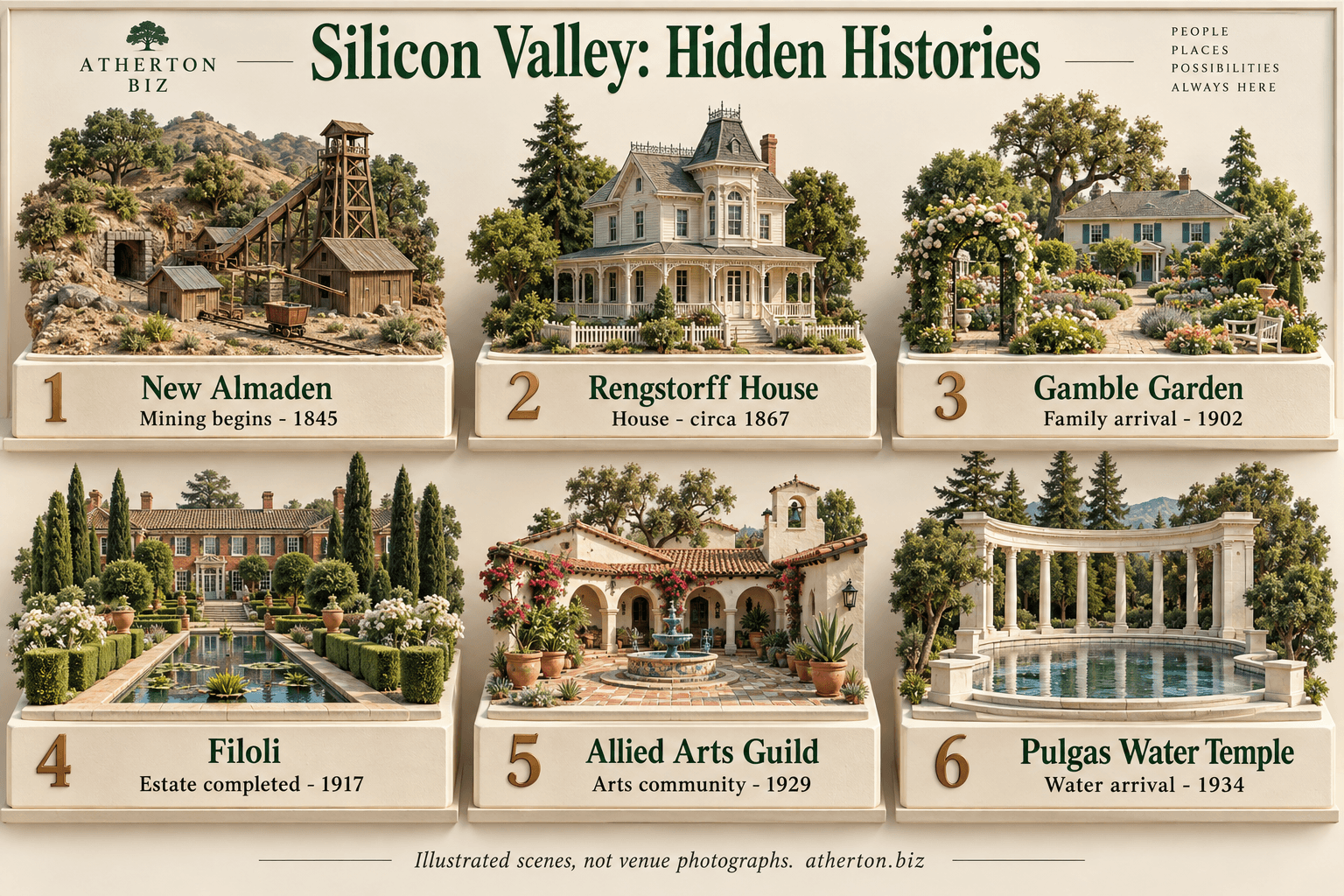
Before the tech campuses: six milestones behind places you can visit today. AI-generated 3D editorial scenes, not venue photographs or exact building reconstructions. Dates are historical reference points, not a route or a complete regional timeline. View full-size image.Key Takeaways
Start nearby with Allied Arts Guild in Menlo Park or Gamble Garden in Palo Alto; save New Almaden in southern San Jose for a separate, longer outing.
Filoli is the well-known anchor, not a secret find. The smaller gardens, water temple and preserved house offer a different scale of discovery.
These places connect art, water, mining and preservation. Read their history before you arrive, then check each operator's current access information.
If you are looking for things to do near Atherton, it is tempting to start with the biggest attraction or the newest restaurant. Try a different question: what happened here before the region became synonymous with technology? A garden can tell a story about civic generosity. An elegant house can reveal an earlier economy. A monument beside a reservoir can make ordinary tap water suddenly seem extraordinary.
This is a choose-your-own day-trip guide, not a six-stop driving itinerary. The first two places are in neighboring Peninsula cities; the others stretch toward Woodside, Mountain View and southern San Jose. Hidden gem is an editorial description here, not a claim that these places are undiscovered. Start with the stop that interests you most, leave room to linger, and resist turning a day out into a checklist.
Menlo Park / Gardens, craft and architecture
1. Allied Arts Guild: an artists' enclave with an Ansel Adams connection
At Allied Arts Guild, make the courtyards part of the visit rather than simply passing through them on the way to a shop. The setting is the point: a place designed around making things, looking closely and taking your time.
Its modern story began in 1929, when Delight and Garfield Merner bought part of a Menlo Park farm. Working with architect Gardner Dailey and artist Pedro de Lemos, they developed an arts community that incorporated existing farm buildings and new Spanish Colonial-style architecture. The iron and wood workshops helped build the complex itself. Ansel Adams served as its photographer of record, documenting the completed interiors and exteriors.
That background gives the Guild a different character from a shopping center with attractive landscaping: the craft tradition is built into the place. Visit at 75 Arbor Road. The venue lists Monday-Saturday opening and Sunday and national-holiday closures; check individual shop and cafe schedules. If photography is the purpose of your visit, read its permit requirements first.
2. Gamble Garden: a family garden that became a public gift
Gamble Garden is a good counterpoint to the grand-estate day out. Come to notice the shape of a garden room, the changing planting and the relationship between an old house and its grounds. You do not need to fill an entire day to appreciate it.
The Gamble family moved to Palo Alto in 1902. Elizabeth Frances Gamble later spent much of her life in the family home, and on her death in 1981 she left the property to the City of Palo Alto. A community campaign helped turn that bequest into a public garden in 1985. Its history is not just the story of one family's taste; it is also a story of what volunteers and preservation advocates chose to keep available to everyone.
The garden at 1431 Waverley Street describes general garden access as free. Its self-guided material is a useful companion, but parts of the property can close for private events. Check posted signs and do not assume that the historic house is open whenever the garden is.
Filoli is hardly hidden, but its history earns it a place beside the quieter discoveries. Rather than treating the house and garden as a backdrop, look for the connections between wealth, infrastructure and the work required to maintain an estate.
The house was completed in 1917 for Agnes and William Bowers Bourn II. Bourn's income came largely from the Empire Gold Mine, with further investments in utilities. The Roth family bought Filoli in 1937, adding another chapter to its preservation story. Even the name is invented: Filoli joins the first two letters of fight, love and live, the key words in Bourn's personal motto.
There is an older history here, too. Filoli identifies the estate as standing on the unceded ancestral homeland of the Lamchin, a tribe of the Ramaytush Ohlone peoples. The estate story should not be mistaken for the beginning of the landscape's human history. Read the site's interpretation alongside the gardens, and check its admission calendar before making plans. As checked September 5, 2026, Filoli also posted a temporary closure for September 6, with reopening planned September 7.
4. Pulgas Water Temple: the monument behind your glass of water
A classical water temple is an unexpected thing to encounter on a Peninsula outing. Pulgas becomes even more interesting when you understand what it commemorates: a regional system that is usually hidden beneath streets and behind utility infrastructure.
On October 28, 1934, a celebration here marked the arrival of Hetch Hetchy water after its journey from the Sierra Nevada. SFPUC describes a system carrying water more than 160 miles, and a Beaux Arts design by William Merchant that borrowed the architectural language of ancient engineering. The historical reference point is the water's arrival, not a claim that every part of the present structure dates unchanged to that ceremony.
This is a particularly useful stop to consider alongside a Woodside outing, but the access detail matters: SFPUC says the parking lot closes on weekends and federally observed holidays. Pedestrian access has its own hours, and Saturday weddings can close the grounds. Check the official page before traveling, do not improvise roadside parking, and note that dogs are not allowed.
5. Rengstorff House: a Victorian survivor beside the modern Valley
The Rengstorff House offers a change of scale from Mountain View's contemporary campuses. Look at the symmetry, roofline and ornamental details: this is an invitation to imagine an earlier built environment, not another technology landmark.
The City dates the house to around 1867 and describes it as Mountain View's oldest home. Its continued existence was not inevitable. After a fire and years of disrepair, preservation advocates worked to save it. The structure was moved twice, restored and opened to the public in 1991. What you see today is therefore both a nineteenth-century house and the result of a much later community decision to preserve it.
The house is at 3070 North Shoreline Boulevard. Use the City's public-tour information rather than assuming that a visit to Shoreline guarantees entry inside. Tours and private rentals have different arrangements. If your main interest is the interior, make the tour schedule the starting point for the day.
6. New Almaden: the mercury story behind the Gold Rush
New Almaden is the longer journey in this guide, not a quick extra stop between Peninsula errands. Go when you have time for the museum's interpretation and, if conditions suit, a separate walk on designated park trails.
Mining began here in 1845, before the California Gold Rush. The valuable product was mercury, also called quicksilver, which was used to separate gold and silver from ore. The National Park Service explains that New Almaden took its name from the mercury-mining district in Spain. This is the surprising connection: a place in today's Silicon Valley helped supply the processing material behind fortunes made elsewhere.
The County's history also describes diverse mining communities and dangerous labor, not simply industrial success. Read that alongside the environmental cleanup story. Casa Grande, built in 1854, now houses the Almaden Quicksilver Mining Museum at 21350 Almaden Road. Museum hours and park access are different, so verify both if you plan to combine them. Do not enter mine workings, climb historic structures or treat old mining material as a souvenir.
For gardens and craft, choose Allied Arts Guild or Gamble Garden. For an estate-and-infrastructure theme, start with Filoli and consider Pulgas only if its access arrangements work that day. For preserved architecture, build around a Rengstorff House tour. For a deeper industrial-history day, make New Almaden the destination rather than an afterthought.
These are editorial pairings, not timed routes. We have not measured current travel times or surveyed accessible paths. Check opening calendars, ticket requirements, weather, mobility needs and private-event closures with each operator. The best version of this trip leaves room to read a panel, ask a question or sit with a view.
Allied Arts Guild in Menlo Park and Gamble Garden in Palo Alto make useful starting points for a smaller outing. New Almaden is in southern San Jose and is better treated as a separate trip. These are geographic suggestions, not live drive-time estimates.
Is Filoli a hidden gem?
It is a well-known attraction. We include it as a historical anchor alongside smaller or less obvious stops, not because it is undiscovered.
Can I visit all six in one day?
We do not recommend using this as a six-stop itinerary. Different tour schedules, garden closures and parking rules make a focused one- or two-stop plan more useful.
Methodology
Researched September 5, 2026 using venue, municipal, county and National Park Service sources linked beside each section. This is an independent editorial guide, not a firsthand inspection or live availability feed. We omit exact construction dates where sources differ: the Gamble timeline marks the family's 1902 arrival, and the Rengstorff date remains approximate.
Closing Thought
Silicon Valley is not only a place that invents the next thing. It is also a landscape of older decisions: what to extract, where to bring water, what to build, and what to save. Knowing a little of that history turns an afternoon near Atherton into something richer than a change of scenery.
More Essays
Continue reading
Local History & Cafes · 5 min read
Coffee With a Past: Historic Cafes Near Atherton
Explore Cafe Wisteria, Cafe Borrone and Coupa Cafe near Atherton, with local history, a 3D infographic, addresses and practical visiting tips.
What Atherton's 2026 Council Records Keep Returning To
Reviewing Atherton's official January 21, February 18, and March 18, 2026 council records shows three dominant themes: housing compliance, operations modernization, and resident-facing rules.
Two Gold Rush Success Stories That Were Really About Positioning
A tighter look at why some of the most durable Gold Rush fortunes came from serving demand intelligently, not simply chasing the same dream as everyone else.