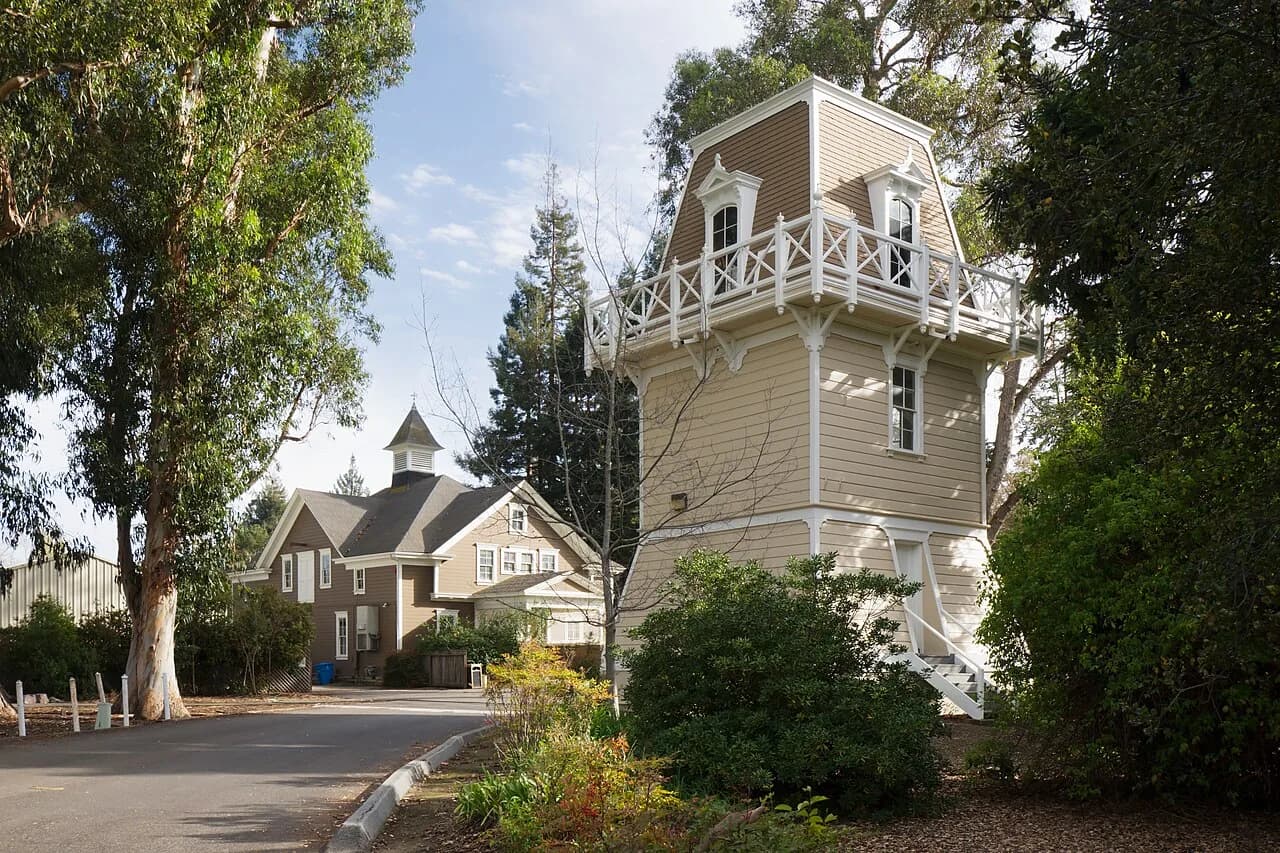
Fair Oaks, before the name Atherton
The old station points back to Fair Oaks, the rail flag-stop identity that preceded the town's 1923 incorporation as Atherton.
Atherton is usually flattened into price, privacy, and prestige. This refreshed guide treats it as a layered town: Rancho land, Fair Oaks rail stop, estate colony, residential incorporation, civic park story, and modern Silicon Valley orbit.

The old station points back to Fair Oaks, the rail flag-stop identity that preceded the town's 1923 incorporation as Atherton.

Holbrook-Palmer Park is the best visual shorthand for a central Atherton pattern: private estates becoming public memory and community space.
James Thomas Watkins' Fair Oaks house, now associated with Alejandra Avenue, is a rare image that lets the estate era feel concrete instead of abstract.
The Town's own history gives this page a better story architecture than a celebrity list. Atherton's people story starts with land, rail access, estate builders, incorporation politics, and an intentional preference for large residential parcels.
The best People of Atherton angle is not "who lives behind which gate." It is "how people shaped the place, and how the place keeps shaping public life."
The Atherton area was once part of Rancho de las Pulgas, the larger Spanish land-grant landscape that later became much of southern San Mateo County.
Faxon Dean Atherton purchased more than 600 acres and later became the namesake for the town, giving the page a human origin story beyond modern wealth rankings.
The Town's official history describes Fair Oaks as a railroad flag stop serving farmers, ranchers, and large-estate owners north of Menlo Park.
Early estate owners shaped street names, landmarks, and neighborhood memory, including Almendral, Ringwood, Lindenwood, Holmgrove, and the Watkins house.
Fair Oaks property owners incorporated separately from Menlo Park and chose the Atherton name after learning Fair Oaks was already used by another California town.
Olive Holbrook-Palmer left a 22-acre park to the town, creating one of the clearest bridges between Atherton's estate past and civic present.
Public reporting has long associated Atherton with major finance figures, including Charles Schwab, which helps explain why the town appears in business and wealth coverage.
Coverage of Atherton real estate has connected the town to former Google CEO Eric Schmidt, making it part of the public story of Silicon Valley leadership.
Public reporting has also connected Atherton with prominent technology leaders and philanthropists such as Sheryl Sandberg.
Atherton's public image reaches beyond technology and finance into Bay Area sports, culture, and legacy.
These are designed to be visually strong without crossing privacy lines: public places, trees, civic assets, street-name history, and community contribution rather than private-home exposure.
A visual guide to Almendral, Alejandra, Fair Oaks, Selby, Lindenwood, and the family or estate histories behind the names.
A photo essay connecting Holbrook-Palmer Park, Town Hall, the library, and the idea of inherited private space becoming public usefulness.
A seasonal story about native live oaks, white oaks, bays, redwoods, cedars, and the canopy that gives Atherton its quiet visual language.
A companion story to the giving map that explains how public donations, schools, parks, safety, and family-support efforts shape the town's identity.
The community giving map is the natural next click because it turns public donations, naming opportunities, school support, park projects, and civic efforts into a more concrete view of impact.
The page uses the Town of Atherton's official history plus Wikimedia Commons media pages so historical claims and images stay traceable.
This page works best as a hub that sends readers into the zip-code guide, open-house dashboard, giving map, and luxury-living pages.
If you want context for a house search, an estate lane, or a possible purchase, use the address tool below. It gives a complimentary preview based on public-record and neighborhood context only.
This feature does not reveal or infer private homeowner identity. It is designed for place-based research, not personal exposure.